
NBA’s $76 Billion Media Deal: Betting Integration, Broadcast Partners, and Scandal Risk
 Available in US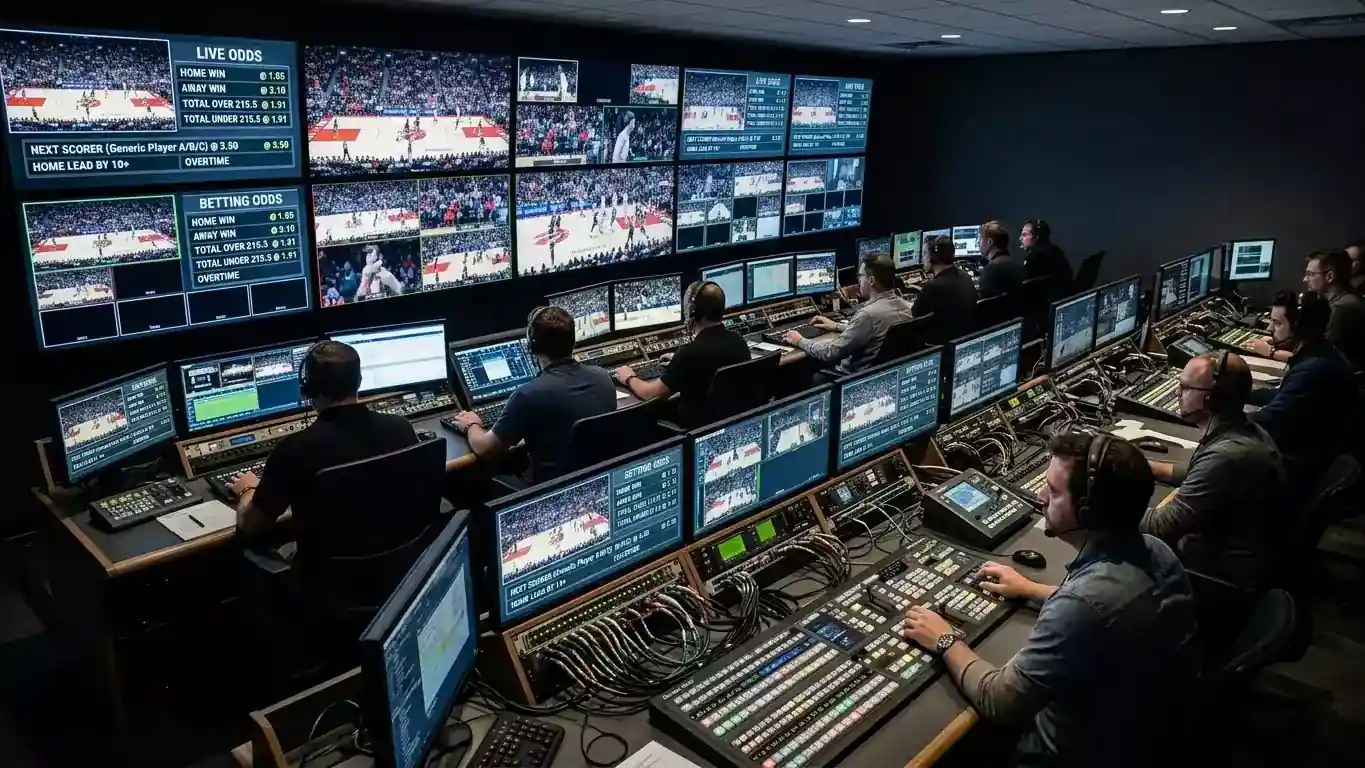
The NBA’s 11-year, $76 billion media deal with Amazon, ESPN/ABC, and NBC is the single largest financial commitment in the history of professional basketball. It guarantees each franchise more than $250 million per year in national media revenue alone, and it is the primary reason that average franchise values have climbed to $5.51 billion. The deal was signed in 2024 and began with the 2025-26 season — launching into the teeth of the worst gambling scandal the league has ever faced. The timing could not have been worse, and the structural implications could not be more significant.
What makes this media deal different from its predecessors is not just the price tag but the product. Betting integration — live odds, prop bet suggestions, in-game wagering prompts — is woven into the broadcast fabric. The networks paid for an audience whose engagement is increasingly driven by gambling. The scandal threatens the very engagement model that justified the investment.
Amazon, ESPN, NBC: Who Pays What
The deal divides NBA broadcasting rights among three partners, each serving a different strategic purpose. ESPN/ABC retained its longstanding relationship with the league, anchoring the package with traditional broadcast and cable coverage. NBC returned to NBA broadcasting after more than two decades, bringing the league back to free-to-air television for a broader audience. Amazon, the most significant new entrant, secured exclusive streaming rights for a substantial portion of the schedule, marking the NBA’s most ambitious step into the digital-first broadcasting era.
The combined value — $76 billion over 11 years — reflects both the NBA’s current audience appeal and the projected growth of sports as a live-event premium in an increasingly fragmented media landscape. Projected league revenue for the 2025-26 season stands at $14.3 billion, with the media deal representing the single largest component. Each network justified its investment partly on the basis that live sports remain one of the few content categories that resist time-shifting and cord-cutting, and that betting integration makes live viewership even stickier.
That last point is critical. Amazon’s streaming model, in particular, depends on real-time engagement. A viewer watching an NBA game on Amazon Prime Video can see live odds, receive personalised prop bet suggestions, and — in states where it is permitted — navigate directly to a wagering platform without leaving the streaming interface. The betting integration is not an add-on; it is a core component of the value proposition that Amazon is selling to advertisers and subscribers.
Odds, Props, and Live Lines: Betting Inside NBA Broadcasts
Turn on any NBA broadcast in the 2025-26 season and you will encounter gambling content within minutes. On-screen graphics display live point spreads and game totals. Commentators reference prop bet lines for individual players — “LeBron’s over-under on assists tonight is set at 7.5” — as naturally as they discuss shooting percentages. Dedicated segments during timeouts and half-time breaks analyse betting angles, review in-game line movements, and highlight same-game parlay opportunities.
In-play betting content is the fastest-growing segment. With 62.35% of online sports wagers in the US placed as live bets during games, the broadcasts are designed to feed that behaviour in real time. A viewer watching a player hit three consecutive three-pointers might see a prompt suggesting an over bet on his threes total for the game. A close game entering the fourth quarter triggers live spread updates that invite last-minute wagering. The experience is engineered to blur the boundary between watching basketball and betting on basketball.
For broadcasters, this integration drives measurable engagement. Viewers who bet on a game watch longer, interact more with second-screen content, and demonstrate higher advertising recall — metrics that directly affect what networks can charge advertisers. The NBA’s media partners structured their deals partly around the expectation that betting would amplify these metrics over the 11-year term. Any event that disrupts the betting-viewership connection — such as a scandal that makes fans question whether the on-court product is genuine — carries implications that extend far beyond sports integrity into billions of dollars of contractual value.
How a Gambling Scandal Complicates Betting-Integrated TV
The 2025 scandal places broadcasters in an awkward position. They have committed billions of dollars to a product whose value is partly derived from gambling engagement, and that product has just been revealed to contain gambling corruption. The editorial challenge is immediate: how do you promote NBA prop bets during a broadcast when the audience knows that NBA prop bets have been manipulated?
Adam Silver acknowledged the tension when he told a media audience that he wished for federal gambling legislation rather than the current state-by-state patchwork. Michael Lewis, commenting on the scandal, warned that leagues “are going to poison their sports if they don’t watch out” and cautioned that while public questioning of game integrity has not reached a critical level, “we’re not that far away.” For broadcasters, that tipping point represents a commercial catastrophe: if a meaningful segment of the audience concludes that games might be fixed, the engagement premium that betting integration provides could reverse into an engagement penalty.
In the short term, the media deal is contractually secure. Amazon, ESPN, and NBC cannot reduce their payments based on the scandal, and none has publicly indicated any desire to renegotiate. But the deal runs until the mid-2030s, and the next negotiation will reflect how the league handles the current crisis. If the scandal proves to be an isolated incident that is followed by meaningful integrity reforms, the media deal’s value is likely preserved. If additional scandals emerge, if trials produce damaging revelations, or if public trust erodes measurably, the leverage dynamic between the league and its broadcast partners will shift — and $76 billion of contractual certainty will begin to feel rather less certain. Check out our guide on NBA Players Betting on Their Own Games: The Ultimate Line That Was Crossed as well.
NBA on UK Television: Sky Sports, TNT Sports, and Betting Ads
British viewers access NBA content primarily through Sky Sports and TNT Sports, both of which hold rights to broadcast regular-season and playoff games in the UK market. The British broadcast experience differs from the American one in several ways, most notably in the regulatory treatment of gambling advertising.
UK broadcasting regulations restrict gambling advertising during live sport more tightly than American rules. The “whistle-to-whistle” advertising ban, introduced in 2019, prohibits gambling advertisements during live sports broadcasts before the watershed, with additional restrictions around content likely to appeal to young audiences. These rules apply to NBA broadcasts shown in the UK, meaning that the betting integration content embedded in American feeds — the on-screen odds, the prop bet suggestions, the sportsbook sponsor logos — is either modified or removed for the British audience.
The regulatory contrast is striking. An American viewer watching an NBA game on Amazon sees a seamless blend of sport and gambling content. A British viewer watching the same game on Sky Sports sees the sport with the gambling content largely stripped out. The underlying game is identical, but the commercial presentation is shaped by national regulation. For British fans following the scandal, the contrast raises a question worth considering: if gambling integration is commercially valuable enough to justify $76 billion in media rights, and if that integration is partly responsible for the conditions that produced the scandal, what does it mean that British regulators have already decided to limit it?
Discover everything about nba player caught betting here.
How much is the NBA’s new media deal worth?
The NBA’s media deal, signed in 2024 and beginning with the 2025-26 season, is worth $76 billion over 11 years. The rights are divided among three broadcast partners: Amazon, ESPN/ABC, and NBC. The deal guarantees each of the 30 NBA franchises more than $250 million per year in national media revenue and is the primary driver behind the league’s current franchise valuations, which average $5.51 billion.
How does betting integration in NBA broadcasts affect UK viewers?
UK viewers are largely shielded from the gambling integration that characterises American NBA broadcasts. British broadcasting regulations, including the whistle-to-whistle ban on gambling advertising during live sport, require that betting-related content — such as live odds overlays, prop bet suggestions, and sportsbook sponsor logos — be modified or removed from NBA broadcasts shown on Sky Sports and TNT Sports. British viewers see the same game as American viewers but without the gambling content that is commercially central to the US broadcast experience.
Published by the nba Player Caught Betting team.